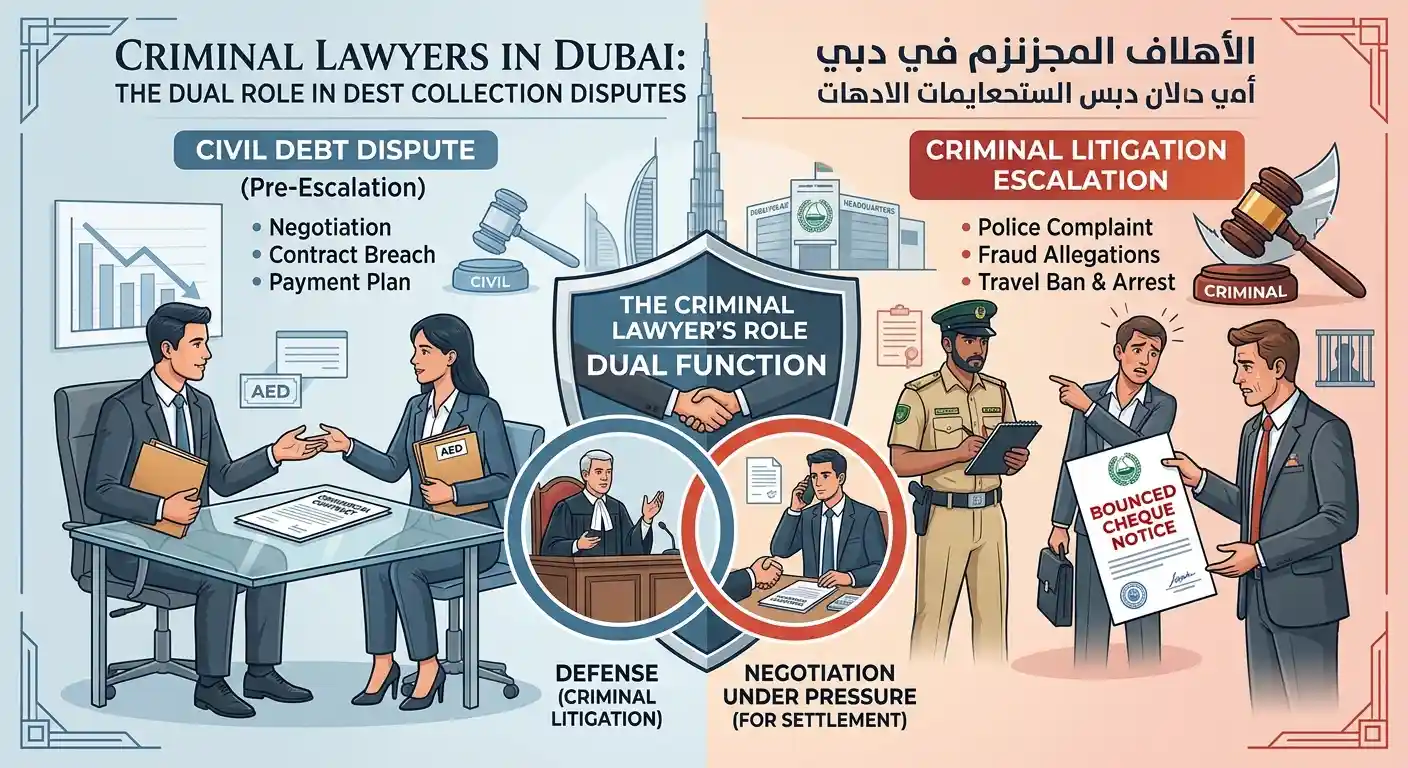
Debt collection disputes can sometimes develop into complex legal matters when disagreements involve allegations of fraud, forged documents, dishonest conduct, or other potentially criminal activity. Although most unpaid debts are handled through civil or commercial recovery procedures, certain circumstances may raise issues that require criminal legal advice. Understanding the distinction between a civil debt dispute and a potential criminal matter is essential for creditors and debtors in Dubai.
Dubai lawyers can provide legal assistance when a debt-related dispute involves allegations that may fall under UAE criminal law. They can assess the circumstances, explain the applicable legal requirements, advise clients about investigations, and represent eligible clients in criminal proceedings. However, an ordinary failure to repay a loan or settle an invoice does not automatically constitute a criminal offence.
This article explains when criminal lawyers may become involved in debt collection disputes, how criminal and civil proceedings differ, and what individuals and businesses should consider when seeking legal assistance.
- Understanding the Difference Between Civil Debt and Criminal Matters
The first step in resolving a debt dispute is determining whether the issue concerns a contractual payment obligation or potentially criminal conduct.
Civil debt disputes commonly arise when a borrower fails to repay a loan, a customer refuses to settle an invoice, or a business breaches an agreement to pay for goods or services. These matters are generally addressed through negotiation, civil litigation, commercial proceedings, or other applicable dispute-resolution mechanisms.
Criminal matters involve allegations of conduct that may constitute an offence under UAE law. Depending on the facts, these could include fraud, forgery, or certain forms of cheque-related misconduct.

For example, if a company fails to pay an invoice because of cash-flow difficulties, that failure alone does not establish criminal liability. However, if a transaction involves alleged deception or forged documentation, the circumstances may require a separate legal assessment.
Criminal lawyers in Dubai can help determine whether the available facts raise a genuine criminal law issue or whether the appropriate remedy is civil debt recovery.
- When Can Criminal Lawyers Become Involved in Debt Collection?
Criminal lawyers may assist when a debt-related dispute involves conduct that potentially violates criminal legislation.
Situations requiring legal assessment may include:
- Allegations that money was obtained through fraudulent representations.
- Suspected forgery of contracts, invoices, or financial documents.
- Allegations involving deliberately falsified evidence.
- Certain cheque-related offences under applicable UAE law.
- Threats, intimidation, or other potentially unlawful conduct arising during a financial dispute.
The legal classification depends on the evidence and the specific circumstances. A creditor should not assume that a debtor has committed a crime simply because payment has not been made.
Similarly, a debtor who faces a criminal complaint should obtain appropriate legal advice rather than assume that the complaint is automatically valid or invalid.
A qualified lawyer can examine the relevant documents, assess the legal elements of the alleged conduct, and explain the available options.
- Can Criminal Lawyers Help With Fraud-Related Debt Disputes?
Fraud allegations may arise when one party claims that another obtained money, goods, or financial benefits through deceptive conduct.
For example, a business may allege that it transferred a substantial amount of money after receiving false representations about a transaction. Whether that conduct amounts to a criminal offence depends on the evidence, the intention involved, and the applicable law.
Criminal lawyers in Dubai can advise clients on the legal significance of the alleged representations, review communications and transaction records, and explain the process for submitting or responding to a complaint.
Relevant evidence may include bank transfers, agreements, emails, messages, invoices, and records identifying the parties involved.
However, a disagreement over contractual performance or an inability to repay a debt should not automatically be characterized as fraud. The facts must support the legal elements of the alleged offence.
- What Role Do Criminal Lawyers Play in Cheque-Related Disputes?
Cheques have historically played an important role in commercial transactions and payment arrangements in the UAE. When a cheque is returned unpaid, the parties may need to determine whether the matter involves civil enforcement, criminal liability, or both.
The legal consequences depend on the circumstances and the applicable provisions of UAE law. Not every returned cheque results in criminal proceedings, and certain qualifying cheques may be subject to specific enforcement mechanisms.
Criminal lawyers in Dubai can advise clients where a cheque-related dispute involves an allegation of criminal conduct. They can review the cheque, the underlying transaction, relevant bank documentation, and any communications concerning payment.
Where the primary objective is recovering the outstanding amount, a civil lawyer or debt recovery specialist may also be needed to assess the available recovery procedure.
The distinction is important because pursuing a criminal complaint does not automatically guarantee repayment of the underlying debt.
- Can Criminal Lawyers Assist with Allegations of Forgery?
Debt disputes may become more complicated when one party alleges that a signature, contract, invoice, cheque, or other document has been falsified.
For example, a business might dispute a debt because it claims that the purchase order relied upon by the creditor was never authorized. Alternatively, a creditor may suspect that documents were altered to conceal an outstanding obligation.
Criminal lawyers can assess whether the alleged conduct may constitute forgery under UAE law and explain how the matter may be investigated.
Depending on the circumstances, relevant evidence may include original documents, electronic communications, transaction records, and expert examination.
Parties should preserve potentially relevant evidence and avoid altering documents or making unsupported accusations. Legal advice can help ensure that any complaint or response is based on verifiable facts.
- How Can Criminal Lawyers Assist Someone Facing a Debt-Related Complaint?
A person accused of criminal conduct in connection with a financial dispute may need legal representation to understand the allegations and protect their procedural rights.
Criminal lawyers may assist by reviewing the complaint, explaining the relevant legal provisions, organizing supporting evidence, preparing responses, and representing the client where authorized.
They can also help distinguish between a genuine contractual disagreement and allegations involving potentially criminal behavior.
For example, a business owner accused of fraud over an unpaid commercial transaction may need a lawyer to examine the contract, payment records, correspondence, and evidence of the parties’ intentions.
The appropriate response depends on the facts. A person facing an investigation should avoid destroying documents, making misleading statements, or ignoring official notices.
- Can Criminal and Civil Proceedings Take Place Separately?
In some circumstances, a debt dispute may involve both civil recovery proceedings and a criminal investigation. These processes have different purposes and legal requirements.
Civil or commercial proceedings generally focus on determining financial obligations and the remedies available to the creditor. Criminal proceedings focus on whether an offence has been committed and whether criminal responsibility can be established under the applicable law.
For example, a creditor may pursue an appropriate civil remedy to recover an outstanding payment while a separate allegation of fraud is investigated by the competent authorities.
The relationship between the proceedings depends on the nature of the claims, the evidence, and the relevant procedural rules. A criminal complaint should not be used merely as a substitute for ordinary debt recovery.
Where both issues arise, legal advice can help the parties understand their respective rights, obligations, and procedural options.
- What Documents Should You Prepare for a Debt-Related Criminal Matter?
Anyone seeking legal advice about a potentially criminal debt dispute should organize the available evidence before consulting a lawyer.
Useful documents may include:
- Contracts, loan agreements, and purchase orders.
- Invoices, receipts, and account statements.
- Bank transfer records and relevant cheque documentation.
- Emails, text messages, and other communications.
- Documents supporting allegations of deception or forgery.
- Copies of official notices, complaints, or correspondence from authorities.
- A chronological summary of the events and payments involved.
The documents required will depend on the allegation. A lawyer can identify which evidence is relevant and whether additional records or expert analysis may be necessary.
Accurate documentation also helps avoid confusion between the amount owed, the contractual dispute, and any alleged criminal conduct.
- How Do You Choose the Right Lawyer in Dubai?
Selecting a lawyer with experience relevant to the dispute is important. Someone dealing with a straightforward unpaid invoice may primarily need civil or commercial debt recovery assistance, whereas allegations of fraud or forgery may require criminal law expertise.
Before appointing a lawyer, consider the following:
Relevant experience: Ask whether the lawyer has handled similar financial or criminal matters.
Understanding of UAE law: Confirm that the lawyer can advise on the applicable legislation and procedures.
Professional authorization: Verify that the lawyer is appropriately authorized to undertake the representation required.
Clear fees: Request a written explanation of legal fees, potential additional costs, and the scope of services.
Communication: Choose a professional who can explain the available options, risks, and expected procedural steps clearly.
In complex cases, coordinated assistance from criminal and civil legal specialists may be appropriate.
- How Can Businesses Reduce the Risk of Debt-Related Legal Disputes?
Businesses can take practical measures to reduce the likelihood of disputes escalating into complicated legal proceedings.
They should use clear written contracts, verify counterparties where appropriate, maintain accurate financial records, and document changes to payment arrangements. Credit-control procedures and timely invoice follow-ups can also help identify overdue accounts before they become more serious.
When a payment dispute arises, businesses should assess the facts objectively and seek advice before making allegations of criminal misconduct.
Professional debt recovery assistance can help companies pursue legitimate claims through appropriate channels while minimizing the risk of unlawful collection practices.
Conclusion
Criminal lawyers in Dubai can assist with debt collection disputes when the circumstances involve allegations of fraud, forgery, certain cheque-related offences, or other potentially criminal conduct. Their role is to assess the allegations, advise clients on UAE criminal law, and provide representation where appropriate.
However, most ordinary unpaid debts are civil or commercial matters, and non-payment alone does not automatically establish a criminal offence. Creditors should identify the correct legal route before taking action, while debtors facing criminal allegations should obtain qualified legal advice.
By understanding the difference between civil recovery and criminal liability, individuals and businesses can make more informed decisions and pursue Debt collection Dubai matters through lawful and appropriate procedures.